Skin texture
Feel and look at the skin on the trunk, hands, and feet.
Ear shape
Look at how much the rim of the pinna curves in, without folding it.
Breast bud size
Feel the breast tissue between two fingers and estimate its diameter.
Nipple formation
Look at the diameter of the areola, whether it is stippled, and whether its edge is raised.
Plantar creases
Look at the sole with the foot extended, from the toes toward the heel.
Result
0points
Review and change your answers
For guidance only; it does not replace clinical assessment or your facility's protocols. · Reviewed November 2, 2026 by the editorial team · Haroldo Capurro and colleagues (CLAP, Montevideo, Uruguay), 1978
What it measures
It estimates how many weeks of gestation a newborn has based on signs of physical maturity: skin texture, ear shape, breast bud size, nipple formation, and plantar creases. It's useful when the date of the last menstrual period isn't reliable or there was no early ultrasound. Gestational age lets you classify the baby as preterm, term, or post-term and anticipate risks such as hypothermia, hypoglycemia, or feeding problems. It has a margin of error of about two weeks and becomes less accurate in extremely preterm infants.
Used in: Newborns over 29 weeks' gestation, ideally in the first hours of life. The 5-sign somatic version is used at birth and when there are signs of neurological injury or dysfunction.
Score interpretation
| Score | Result | What it means |
|---|---|---|
| 0-55 pts (29.1-37 wk) | Preterm | Less than 260 days (under 37 weeks). Depending on the baby's condition, needs hospital care or NICU admission; monitor temperature, glucose, breathing, and feeding. |
| 56-90 pts (37.1-42 wk) | Term | 260 to 294 days (37 to 42 weeks). If the baby is stable, they can room in with the mother and start exclusive breastfeeding. |
| 91-94 pts (42.1-42.6 wk) | Post-term | 295 days or more (42 weeks or more). Observe closely for the first 12 hours for hypoglycemia or hypocalcemia; then, if stable, the baby can room in with the mother. |
Variations: There is also a somatic-neurological version for healthy newborns older than 12 hours: it uses 4 somatic signs (nipple formation is dropped), adds two neurological signs, the scarf sign and the head lag sign, and uses a constant of 200 days instead of 204. Some national guidelines reserve the 5-sign somatic version with the 204 constant for babies with signs of brain injury or neurological dysfunction. For extremely preterm infants, the New Ballard Score is preferred.
The scale at a glance
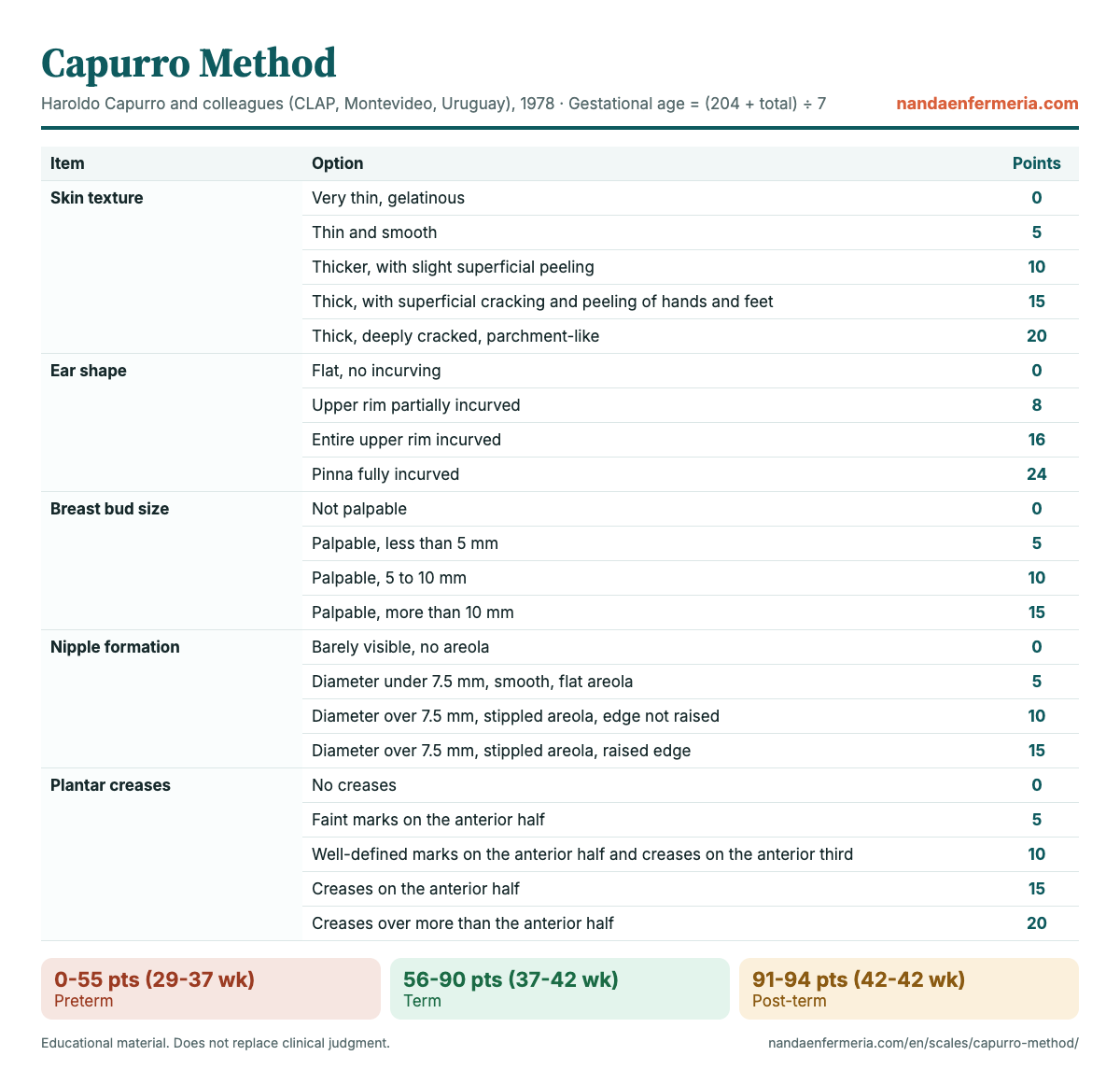
When to use it
- Newborns with no reliable last menstrual period date and no early ultrasound.
- A mismatch between gestational age by dates and the baby's appearance or weight.
- Classifying the newborn as preterm, term, or post-term during the initial newborn assessment.
- Plotting weight against gestational age to identify babies who are small or large for gestational age.
- Newborns with neurological depression, in whom neurological signs can't be assessed.
How to use it step by step
- Assess the baby in the first hours of life, under a radiant warmer with good lighting.
- Examine skin texture, ear shape, breast bud, nipple, and plantar creases.
- Choose the option that best describes each sign and write down its points.
- Add the points and then add the 204 constant to get gestational age in days.
- Divide the result by 7 to express it in weeks, and classify the baby.
- Compare with gestational age by LMP or ultrasound and document the method used.
Common mistakes
- Using the 200 constant with the five somatic signs: 200 belongs to the version with neurological signs.
- Assessing plantar creases late, after the skin of the sole has wrinkled from dehydration or edema.
- Folding the ear or squeezing the breast tissue during the exam, which changes the reading.
- Using it in extremely preterm infants, where the margin of error is larger and the New Ballard Score is a better choice.
- Forgetting that the result is an estimate with a margin of error of about two weeks.
Case study
Patient. Newborn whose mother had no prenatal care and no reliable LMP date; birth weight 2,350 g; assessed at 2 hours of life.
- Thicker skin with slight superficial peeling: 10 points
- Entire upper rim of the ear incurved: 16 points
- Breast bud palpable, less than 5 mm: 5 points
- Nipple with stippled areola, diameter over 7.5 mm, edge not raised: 10 points
- Well-defined marks on the anterior half of the sole: 10 points
Score: 51. 51 + 204 = 255 days, or 36.4 weeks (36 weeks and 3 days). Classified as late preterm.
Nursing actions:
- Maintain a neutral thermal environment and check temperature frequently.
- Monitor point-of-care blood glucose per unit protocol.
- Assess suck and swallow and support breastfeeding.
- Document the estimated gestational age, plot weight for gestational age, and notify the provider.
Related NANDA nursing diagnoses
The score on this scale often supports these nursing diagnoses:
Frequently asked questions
What is a normal Capurro result?
A term newborn scores 260 to 294 days, or 37 to 42 weeks. In the somatic version that equals 56 to 90 points before adding the 204 constant.
How do you calculate gestational age with the Capurro method?
Add the points for the five somatic signs, add the 204 constant, and you have gestational age in days. Divide by 7 to convert to weeks. For example, 60 points + 204 = 264 days, about 37.7 weeks.
When do you use the 200 constant vs. the 204 constant?
Use 204 with the five somatic signs. Use 200 with the somatic-neurological version, which drops nipple formation and adds the scarf sign and the head lag sign.
How accurate is the Capurro method?
It's accurate to within about two weeks either way. That's why it's compared with the last menstrual period and ultrasound dating when they're available.
Capurro vs. Ballard: what's the difference?
Capurro uses a few signs and is quick, but it's only used from 29 weeks on. The New Ballard Score uses 6 neuromuscular and 6 physical signs and is more useful in extremely preterm infants.
Other scales
Sources: Mexican official standard NOM-007-SSA2-2016, Appendix H (Capurro method, Spanish) · Capurro H et al. A simplified method for diagnosis of gestational age in the newborn infant. J Pediatr 1978 · Capurro test. Spanish-language Wikipedia · Newborn assessment scales. UNISA, Mexico City Government (Spanish). Explanatory text and case study written by our editorial team. Reviewed November 2, 2026.