Which level best describes the patient?
Observe first; if the patient is asleep, speak to them, and if there's no response, give a light glabellar tap or a loud auditory stimulus.
Result
0range 1 to 6
Review and change your answers
For guidance only; it does not replace clinical assessment or your facility's protocols. · Reviewed November 2, 2026 by the editorial team · Ramsay, Savege, Simpson and Goodwin, 1974
What it measures
It describes how awake, calm, or sedated a patient is based on behavior and response to voice or a physical stimulus. It helps you titrate sedation to the target set by the provider, catch oversedation or agitation, and leave a record that can be compared from shift to shift in the ICU, the OR, and during procedural sedation.
Used in: Sedated adults in the ICU, during procedures, or postoperatively. It is also used in pediatrics and palliative care.
Score interpretation
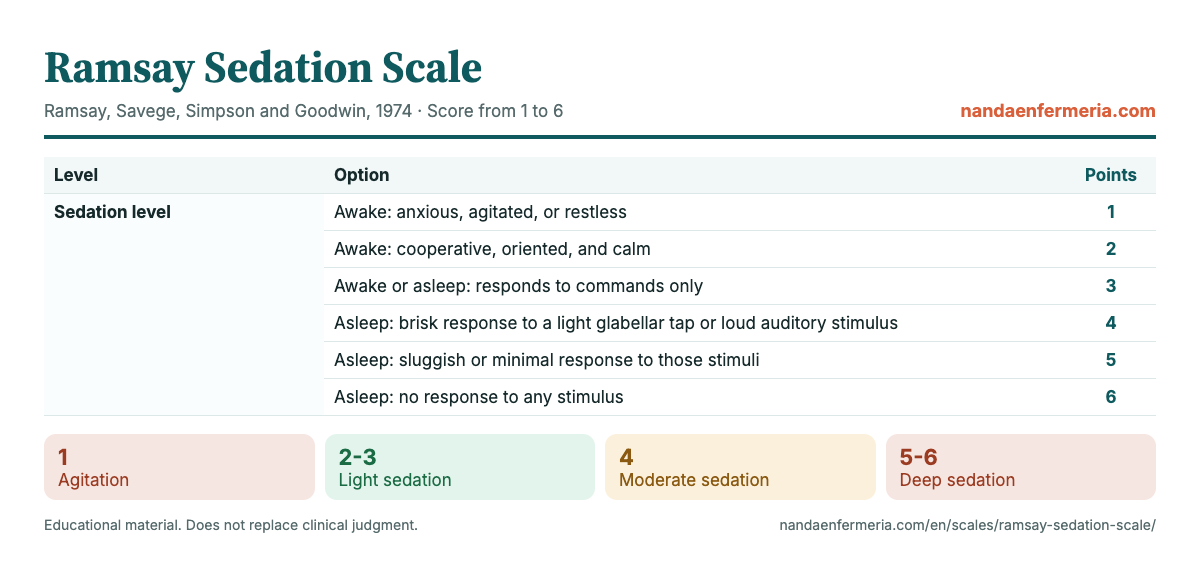
| Score | Result | What it means |
|---|---|---|
| 1 | Agitation | Undersedation or agitation. Look for causes such as pain, hypoxia, bladder distention, or delirium, protect lines and tubes, and notify the provider. |
| 2-3 | Light sedation | Calm patient who cooperates or follows commands. This is the usual target for most patients; keep monitoring. |
| 4 | Moderate sedation | Asleep but responds briskly to stimulation. May be acceptable if ordered; confirm it matches the prescribed target. |
| 5-6 | Deep sedation | Minimal or no response. Unless this is the ordered target, it suggests oversedation: monitor breathing and hemodynamics and notify the provider. |
Variations: Some versions describe level 4 as 'brisk response to light or sound' and level 5 as 'responds only to pain'; the meaning is the same. The target range varies by guideline: 2-3 is the most commonly cited, and some protocols accept 2-4. For ICU sedation, many current guidelines prefer the Richmond Agitation-Sedation Scale (RASS), which separates degrees of agitation more clearly.
The scale at a glance
When to use it
- Mechanically ventilated ICU patients on continuous sedation.
- Before, during, and after procedural sedation (endoscopy, bronchoscopy, painful dressing changes).
- Post-anesthesia recovery (PACU).
- Monitoring palliative sedation in end-of-life care.
- Patients on opioids or sedatives when you need to watch for oversedation.
How to use it step by step
- Check the target sedation level the provider ordered for this patient.
- Observe the patient for a few seconds without stimulating them: if awake, decide whether they are agitated (1) or calm and cooperative (2).
- If they appear to be asleep, call them by name and give a simple command: if they follow it, that's level 3.
- If there's no response to voice, give a light glabellar tap or a loud auditory stimulus and decide whether the response is brisk (4), sluggish (5), or absent (6).
- Document the level with the time and compare it with the target; report any deviation.
Common mistakes
- Using a strong stimulus before trying voice first, which makes sedation look deeper than it is.
- Treating level 6 as 'well sedated' without confirming it was the ordered target.
- Scoring a 1 without looking for the cause of agitation, such as pain or hypoxia.
- Scoring a patient on neuromuscular blockade, in whom the scale is not valid.
- Not documenting the time or the target, which makes shift-to-shift trends impossible to see.
Case study
Patient. 62-year-old woman in the ICU on mechanical ventilation for pneumonia; the ordered sedation target is Ramsay 2-3.
- She is asleep and doesn't open her eyes when you call her name.
- She doesn't follow the command to squeeze your hand.
- A light glabellar tap produces only a weak, delayed grimace.
- Level assigned: 5 (sluggish or minimal response).
Score: 5. Ramsay 5: deep sedation, deeper than the ordered target of 2-3. This suggests oversedation.
Nursing actions:
- Notify the provider that the patient is more sedated than the target.
- Review infusion rates with the team and document any ordered changes.
- Monitor respiratory rate, ventilator synchrony, blood pressure, and SpO2.
- Protect the eyes and skin because of immobility.
- Reassess the Ramsay level per protocol after every change.
Related NANDA nursing diagnoses
The score on this scale often supports these nursing diagnoses:
Frequently asked questions
What is the target Ramsay score?
For most patients the goal is level 2 or 3: calm and able to follow commands. Some protocols accept up to 4. Level 1 means agitation, and levels 5 and 6 mean deep sedation, which is only appropriate when the provider ordered it.
How many levels does the Ramsay Sedation Scale have?
Six. The first three describe a patient who is awake or responds to voice, and the last three describe a sleeping patient based on how they respond to a stimulus.
What's the difference between the Ramsay scale and RASS?
Ramsay has only one level for agitation. RASS runs from +4 to -5 and separates several degrees of agitation and sedation, which is why many ICU guidelines prefer it.
What does a Ramsay score of 6 mean?
The patient doesn't respond to any stimulus. That's very deep sedation; if it wasn't ordered, notify the provider and closely monitor breathing and circulation.
Can you use the Ramsay scale on a paralyzed patient?
No. With neuromuscular blockade the patient can't move even if awake, so the scale doesn't reflect their true level of sedation.
Other scales
Sources: Ramsay sedation level scale - Andalusian Health Service (Spanish) · Analysis of 4 sedation assessment scales - Enfermería Intensiva (Elsevier, Spanish) · Sedation and analgesia - SATI Nursing Chapter (Spanish) · Controlled sedation with alphaxalone-alphadolone (Ramsay, BMJ 1974). Explanatory text and case study written by our editorial team. Reviewed November 2, 2026.