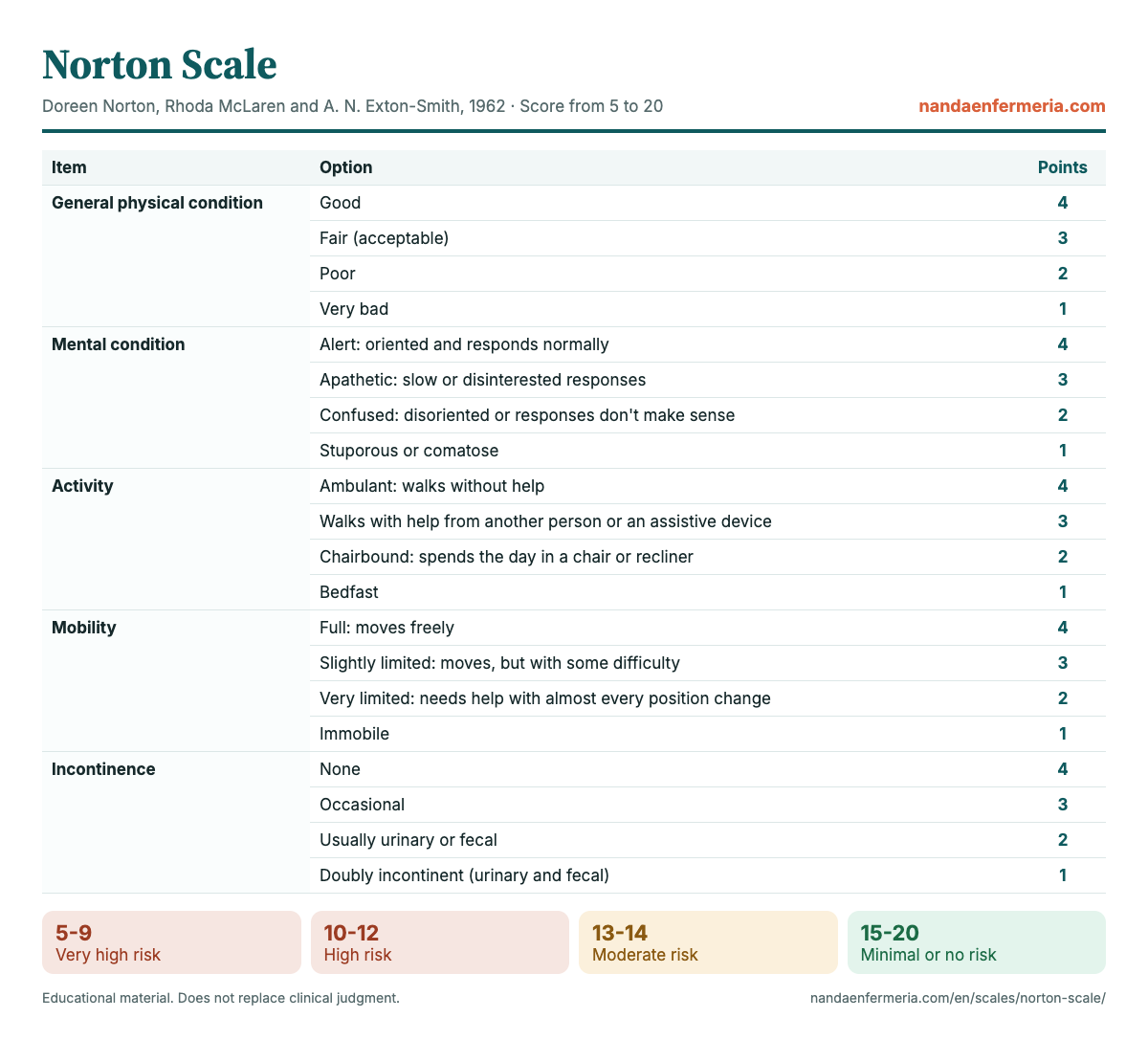
General physical condition
Consider nutrition, hydration, temperature, and overall health.
Mental condition
Level of consciousness and orientation at the time of assessment.
Activity
Ability to get around.
Mobility
Ability to change and control body position.
Incontinence
Bladder and bowel control.
Result
0range 5 to 20
Review and change your answers
For guidance only; it does not replace clinical assessment or your facility's protocols. · Reviewed November 2, 2026 by the editorial team · Doreen Norton, Rhoda McLaren and A. N. Exton-Smith, 1962
What it measures
It estimates how likely a patient is to develop pressure injuries based on five factors: general physical condition, mental state, activity, mobility, and incontinence. It is quick to complete and helps you decide who needs protection and how aggressive prevention should be. It was the first scale of its kind and is still in use, especially with older adults.
Used in: Adults, especially older adults in the hospital, in nursing homes, or receiving home care.
Score interpretation
| Score | Result | What it means |
|---|---|---|
| 5-9 | Very high risk | Very high likelihood of a pressure injury. Put every prevention measure in place, use a specialty support surface, and inspect the skin every shift. |
| 10-12 | High risk | Set up a repositioning schedule, use a pressure-redistribution surface, and address the items with low scores. |
| 13-14 | Moderate risk | The patient is already at risk. Start preventive measures and reassess as often as your facility's protocol requires. |
| 15-20 | Minimal or no risk | Low risk right now. Continue basic skin care and reassess if the patient's condition changes. |
Variations: The original 1962 scale only states that a score of 14 or less indicates risk. The modified Norton Scale developed by Spain's former national health service (INSALUD) keeps the same five items and point values but defines each option in detail (for example, physical condition based on nutrition, hydration, temperature, and body mass index). Depending on the source, it classifies 5-9 as very high, 10-12 as high, 13-14 as evident, and above 14 as minimal risk (Galician Health Service), or 5-11 as high, 12-14 as evident, and above 14 as minimal (Gerokomos, 2017).
The scale at a glance
When to use it
- On admission of older adults to the hospital, a nursing home, or home care.
- For patients who are bedbound, chairbound, or have reduced mobility.
- When new confusion, incontinence, or a decline in overall condition appears.
- After surgery or an acute illness that requires bed rest.
- At the routine reassessment intervals set by your unit's protocol.
How to use it step by step
- Observe the patient and inspect the skin over the sacrum, heels, hips, and areas under medical devices.
- Score each item from 1 to 4 based on the patient's current status.
- If you're torn between two options, choose the lower score.
- Add the five items: the total ranges from 5 to 20.
- Classify the risk, document it, and flag the lowest-scoring items to target your care.
- Reassess whenever the patient's condition changes or as your protocol requires.
Common mistakes
- Mixing up activity (ability to get around) with mobility (ability to change position).
- Scoring physical condition from the medical diagnosis alone without assessing nutrition and hydration.
- Assuming a patient who scores 15 or higher needs no skin care at all.
- Not repeating the assessment when the patient gets worse or becomes incontinent.
- Using it with children: it is not validated for pediatric patients.
Case study
Patient. 82-year-old man at home, one week after surgical repair of a hip fracture.
- Eating little and somewhat dehydrated: poor physical condition, 2
- Responds slowly and with little interest: apathetic mental condition, 3
- Spends the day in a recliner: chairbound, 2
- Needs help with almost every position change: very limited mobility, 2
- Occasional urine leakage: occasional incontinence, 3
Score: 12. A total of 12 points indicates a high risk for pressure injury.
Nursing actions:
- Use a pressure-redistribution cushion and mattress and set up a repositioning schedule.
- Offload the heels and protect the sacrum; inspect the skin daily.
- Encourage fluid and food intake and request a nutrition consult.
- Keep the skin clean and dry after every incontinence episode.
- Teach the family to reposition him without dragging, and repeat the Norton score at the next visit.
Related NANDA nursing diagnoses
The score on this scale often supports these nursing diagnoses:
Frequently asked questions
What is a normal Norton score, and what score means the patient is at risk?
A score of 15 to 20 is considered minimal risk. At 14 or below the patient is at risk: 13-14 is moderate, 10-12 is high, and 5-9 is very high risk.
What are the lowest and highest possible Norton scores?
The lowest is 5 and the highest is 20. Each of the five items is scored from 1 to 4.
What is the modified Norton Scale?
It's the version developed by Spain's former national health service (INSALUD). It keeps the five items but describes each option in detail so different nurses arrive at the same score.
Norton vs. Braden: which one should I use?
Both are valid. Braden includes nutrition and friction/shear and is the standard in most US hospitals; Norton is quicker and widely used with older adults. Use whichever tool your facility's protocol specifies.
How often should the Norton Scale be done?
On admission, then at intervals based on the risk level and your unit's protocol, and any time the patient's condition changes.
Other scales
Sources: Galician Health Service (SERGAS). Modified Norton Scale (Spanish) · The INSALUD-modified Norton Scale and its differences (Gerokomos, 2017, Spanish) · Virgen de las Nieves University Hospital. Norton Scale questionnaire (Spanish) · IMSS clinical practice guideline: prevention and treatment of pressure ulcers, quick reference (Spanish). Explanatory text and case study written by our editorial team. Reviewed November 2, 2026.