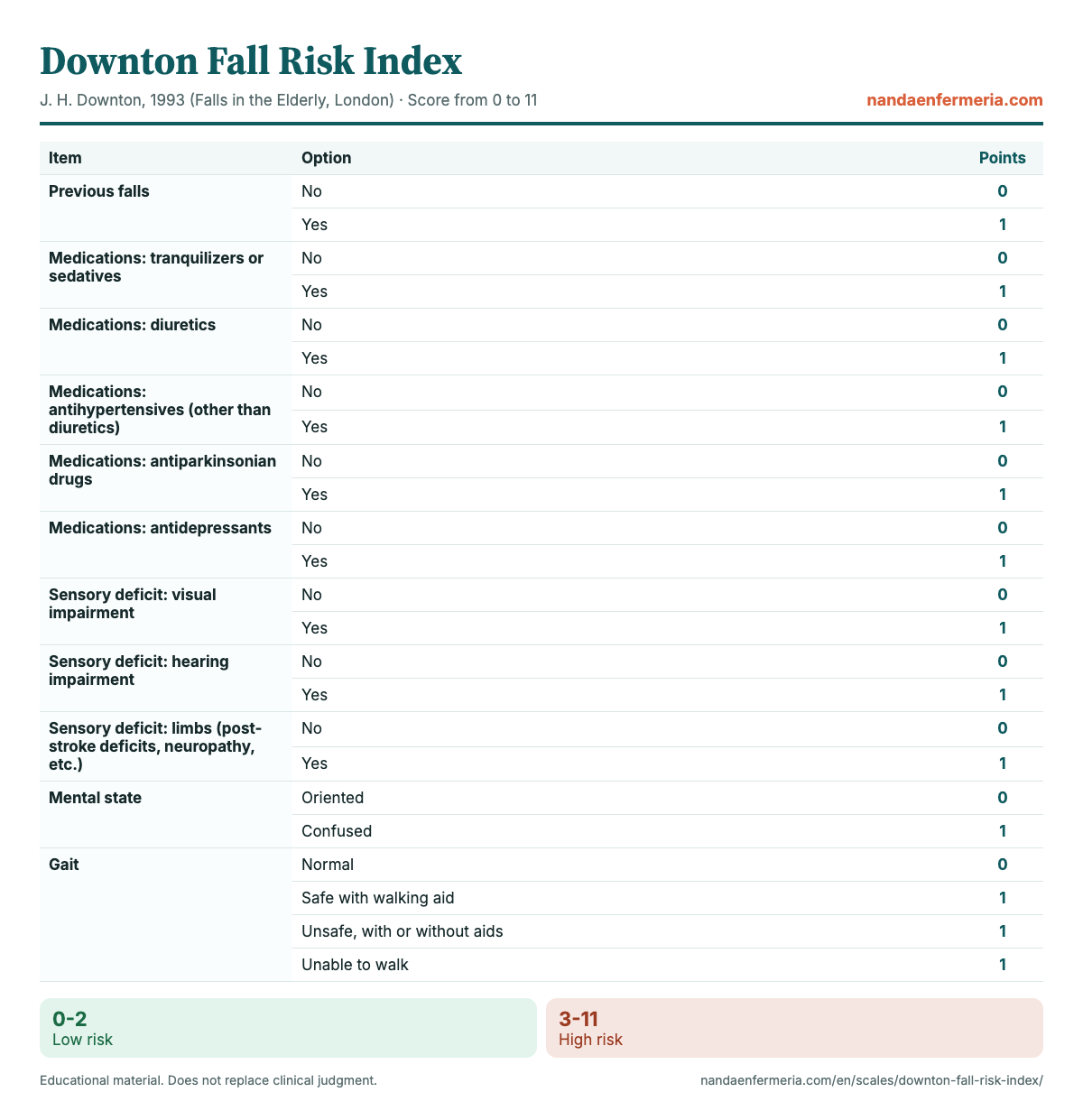
Previous falls
Ask the patient or family whether they have fallen before.
Medications: tranquilizers or sedatives
Check each drug class the patient takes; each one adds 1 point. Other medications don't count.
Medications: diuretics
Medications: antihypertensives (other than diuretics)
Medications: antiparkinsonian drugs
Medications: antidepressants
Sensory deficit: visual impairment
Check each deficit present; each one adds 1 point.
Sensory deficit: hearing impairment
Sensory deficit: limbs (post-stroke deficits, neuropathy, etc.)
Mental state
Assess orientation to person, place, and time.
Gait
Watch the patient walk; don't rely only on what they tell you.
Result
0range 0 to 11
Review and change your answers
For guidance only; it does not replace clinical assessment or your facility's protocols. · Reviewed November 2, 2026 by the editorial team · J. H. Downton, 1993 (Falls in the Elderly, London)
What it measures
It adds up fall risk factors you can identify at the bedside in a few minutes. Each factor present is worth 1 point, so the total reflects how many risk factors the person has. It helps you decide who needs enhanced fall precautions and should be repeated whenever the patient's condition or treatment changes.
Used in: Adults, especially older adults in the hospital, in nursing homes, or in primary care.
Score interpretation
| Score | Result | What it means |
|---|---|---|
| 0-2 | Low risk | Use standard fall precautions and reassess if the patient's condition, medications, or mobility change. |
| 3-11 | High risk | Document the risk, alert the team, and start enhanced fall precautions according to your unit's protocol. |
Variations: Published versions differ on two points. Some guidelines (the Madrid regional health department and several hospitals) give 1 point for 'other medications', which raises the maximum to 12; in the original version and in the Andalusian Health Service version they don't count. For gait, the Andalusian version scores only 'unsafe', while most Spanish-language guidelines also score 'safe with walking aid' and 'unable to walk'; the maximum for that section is still 1.
The scale at a glance
When to use it
- On hospital admission of an adult or older adult.
- After a medication change involving sedatives, diuretics, antihypertensives, or antidepressants.
- After a fall, to reassess risk.
- When mental status changes, such as new confusion or delirium.
- On transfer to another unit or before discharge.
- During routine assessment of older adults in nursing homes or primary care.
How to use it step by step
- Ask the patient and family about previous falls and review the chart.
- Review the medication administration record and check every drug class that scores a point.
- Assess vision, hearing, and limb strength or sensation.
- Assess orientation and watch the patient walk at the time of the assessment.
- Add up the points: 3 or more is high risk.
- Document the score, the date, and the interventions you start; reassess per your protocol.
Common mistakes
- Checking only one medication when the patient takes several of the drug classes that score.
- Scoring gait from what the patient reports without watching them walk.
- Assessing only once on admission and not repeating after clinical or medication changes.
- Missing the limb deficit in patients with post-stroke deficits or neuropathy.
- Relying on the score alone and skipping clinical judgment.
Case study
Patient. 78-year-old woman admitted for acute decompensated heart failure.
- Fell at home two months ago (1 point).
- Takes furosemide (diuretic, 1 point) and losartan (antihypertensive, 1 point).
- Cataracts with blurred vision (visual impairment, 1 point).
- Oriented (0 points).
- Walks safely with a walker (1 point).
Score: 5. High fall risk (5 points, above the cutoff of 3).
Nursing actions:
- Document the risk and apply the visual fall-risk identification your protocol uses.
- Keep the bed in the low position with the brakes locked and the call light within reach.
- Assist her to the bathroom, especially when the diuretic is having its peak effect.
- Check for orthostatic hypotension when she gets up.
- Repeat the Downton score if her treatment or condition changes.
Related NANDA nursing diagnoses
The score on this scale often supports these nursing diagnoses:
Frequently asked questions
What Downton score means high fall risk?
A total of 3 or more points means high fall risk. A score of 0 to 2 is low risk, but standard fall precautions still apply.
What is the maximum score on the Downton Fall Risk Index?
In the original version it's 11 points: 1 for previous falls, up to 5 for medications, up to 3 for sensory deficits, 1 for mental state, and 1 for gait.
If the patient takes several medications, does each one count?
Yes. Each drug class present (sedatives, diuretics, antihypertensives, antiparkinsonian drugs, antidepressants) adds 1 point. The same goes for each sensory deficit.
How often should the Downton index be done?
On admission, whenever the patient's clinical status, medications, or mobility change, and after any fall. The exact frequency is set by each facility's protocol.
Downton vs. Morse Fall Scale: what's the difference?
Downton adds up 1-point risk factors and is widely used with older adults and in primary care. Morse gives different weights to six items, goes up to 125 points, and is used mainly for hospitalized adults.
Other scales
Sources: Fall prevention procedure, Downton scale (Andalusian Health Service, Spanish) · J. H. Downton fall risk scale (Madrid Regional Health Department, Spanish) · Usefulness of the Downton and Tinetti scales (SciELO Cuba, Spanish) · Prediction of falls among older people by the Downton index (Nyberg et al.). Explanatory text and case study written by our editorial team. Reviewed November 2, 2026.