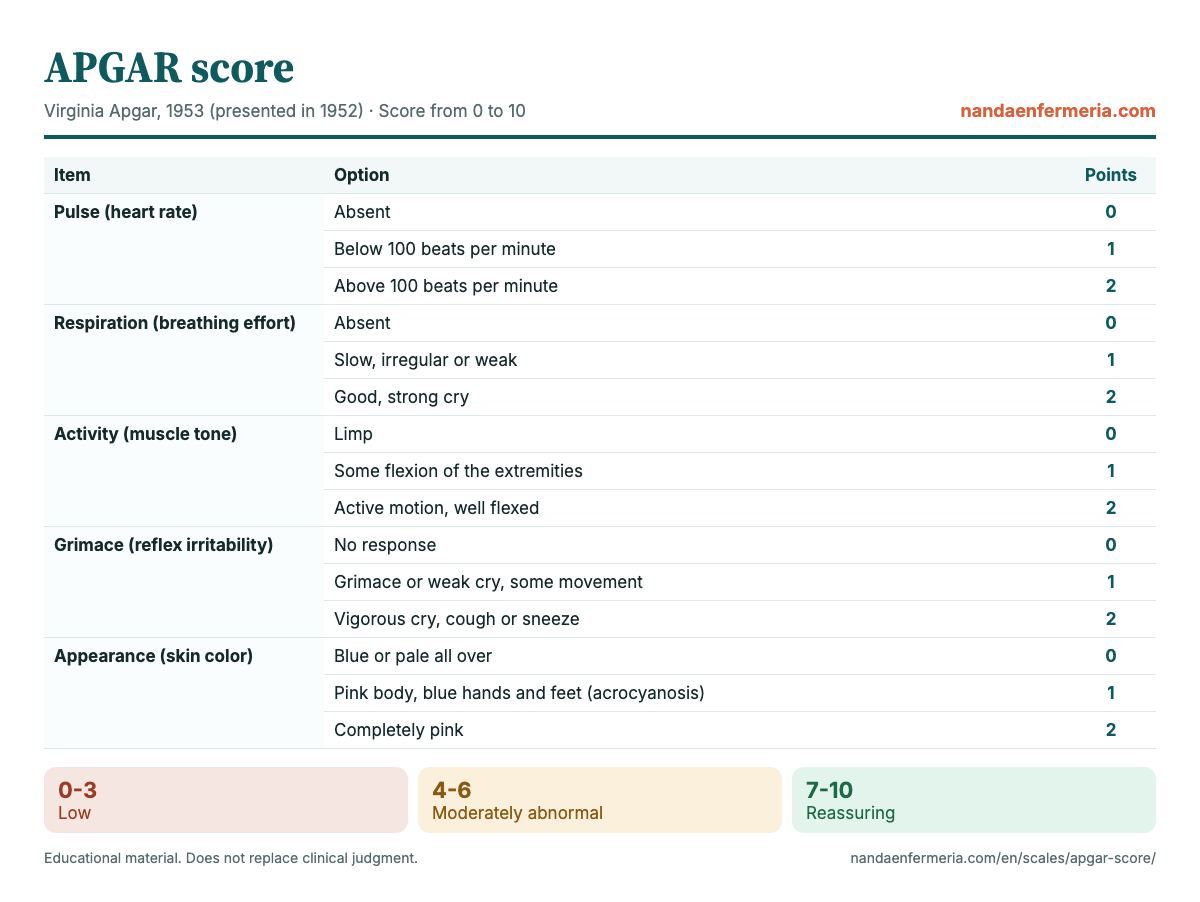
Pulse (heart rate)
Auscultate the precordium or palpate the base of the umbilical cord for 6 seconds and multiply by 10.
Respiration (breathing effort)
Watch the chest and listen to the cry; don't mistake isolated gasps for breathing.
Activity (muscle tone)
Look at posture and the resistance when you extend the arms and legs.
Grimace (reflex irritability)
Assess the response to the suction catheter or to rubbing the sole of the foot.
Appearance (skin color)
Check the trunk, hands and feet in good light; in darker skin, look at the mucous membranes, palms and soles.
Result
0range 0 to 10
Review and change your answers
For guidance only; it does not replace clinical assessment or your facility's protocols. · Reviewed November 2, 2026 by the editorial team · Virginia Apgar, 1953 (presented in 1952)
What it measures
It quickly measures how the newborn is responding in the first minutes after birth: Appearance (skin color), Pulse (heart rate), Grimace (reflex irritability), Activity (muscle tone) and Respiration (breathing effort). The 1-minute score reflects the baby's condition at birth; the 5-minute score shows how the baby responded to transition and to initial newborn care, and it is the one most often used to describe the newborn's status. It is not used to decide whether to start resuscitation, and it does not predict neurologic outcome on its own.
Used in: Term and preterm newborns in the delivery room, at 1 and 5 minutes of life (and every 5 minutes up to 20 minutes if the 5-minute score is below 7).
Score interpretation
| Score | Result | What it means |
|---|---|---|
| 0-3 | Low | The newborn needs immediate attention and resuscitation per your unit's protocol. Document the exact time and repeat the score every 5 minutes. |
| 4-6 | Moderately abnormal | Needs extra attention: stimulation, a clear airway and close monitoring. If the score is still low at 5 minutes, repeat it every 5 minutes up to 20 minutes. |
| 7-10 | Reassuring | Normal transition. Continue routine newborn care, skin-to-skin contact and monitoring of the transition. |
Variations: The AAP and ACOG call 7-10 "reassuring", 4-6 "moderately abnormal" and 0-3 "low". Some guidelines describe the same ranges as no depression (7-10), moderate depression (4-6) and severe depression (3 or less). The AAP and ACOG also propose the expanded Apgar, which also records the resuscitation interventions the baby received.
The scale at a glance
When to use it
- Immediate care of every newborn in the delivery room or OR.
- Required documentation at 1 and 5 minutes in the medical record and birth records.
- Reassessment every 5 minutes up to 20 minutes when the 5-minute APGAR is below 7.
- Tracking the newborn's response during and after neonatal resuscitation.
- Quickly communicating the baby's status among the obstetric, pediatric and nursing teams.
How to use it step by step
- Start a timer the moment the baby is completely delivered.
- At 1 minute, assess the five signs and give each one 0, 1 or 2 points.
- Add up the points and document the 1-minute score with the time.
- Repeat the full assessment at 5 minutes and document the second score.
- If the 5-minute score is below 7, keep scoring every 5 minutes up to 20 minutes and note the interventions performed.
- Share the result with the team and the family in plain language.
Common mistakes
- Waiting until 1 minute to start resuscitation: the APGAR score does not decide whether to resuscitate.
- Scoring from memory at the end of the delivery instead of at the exact minute.
- Taking off points for acrocyanosis in the first minutes as if it were central cyanosis.
- Judging a preterm baby's tone and reflexes by the same standard as a term baby without considering maturity.
- Documenting only the 5-minute score or skipping the extra assessments when it is below 7.
Case study
Patient. A male newborn at 39 weeks, vaginal delivery with a prolonged second stage. Assessment at 1 minute.
- Heart rate 120 beats per minute: 2 points
- Irregular breathing with a weak cry: 1 point
- Some flexion of the extremities: 1 point
- Grimaces when the mouth is suctioned: 1 point
- Pink body with blue hands and feet: 1 point
Score: 6. 1-minute APGAR of 6: moderately abnormal. After drying, stimulating and placing him in the sniffing position, his 5-minute score is 9 (reassuring).
Nursing actions:
- Dry, stimulate and keep the airway clear.
- Prevent heat loss with prewarmed blankets and skin-to-skin contact as soon as possible.
- Repeat the APGAR at 5 minutes and document both scores with the time.
- Monitor respiratory rate, breathing effort and temperature during the transition.
Related NANDA nursing diagnoses
The score on this scale often supports these nursing diagnoses:
Frequently asked questions
What is a normal APGAR score?
A score of 7 to 10 is considered normal (reassuring). 4 to 6 is moderately abnormal and 0 to 3 is low. Few babies score 10 at 1 minute, because bluish hands and feet are normal at that point.
Why is the APGAR score done at 1 and 5 minutes?
The 1-minute score shows the baby's condition at birth. The 5-minute score shows how the baby adapted and responded to initial care. The 5-minute score is more closely related to outcomes and is the one most often used to describe the newborn's status.
What happens if the 5-minute APGAR is below 7?
The score is repeated every 5 minutes up to 20 minutes, and the interventions the baby received are documented. The team adjusts care based on the baby's progress and the unit's protocols.
Does a low APGAR score mean brain damage?
Not on its own. A low score means the baby needed support during transition. Asphyxia or neurologic injury can only be determined with other data, such as umbilical cord blood gases and the clinical course.
Is the APGAR score used to decide whether to resuscitate a newborn?
No. Resuscitation starts based on breathing, tone and heart rate, without waiting for the 1-minute mark. The APGAR score documents the baby's status and response to care.
Other scales
Sources: NOM-007-SSA2-2016, Appendix F (Apgar method, in Spanish) · AAP and ACOG. The Apgar Score (2015) · Pardo A. Apgar score. Hospital Italiano de Buenos Aires (in Spanish) · Care of the healthy newborn. Acta Pediátr Mex 2014 (in Spanish). Explanatory text and case study written by our editorial team. Reviewed November 2, 2026.