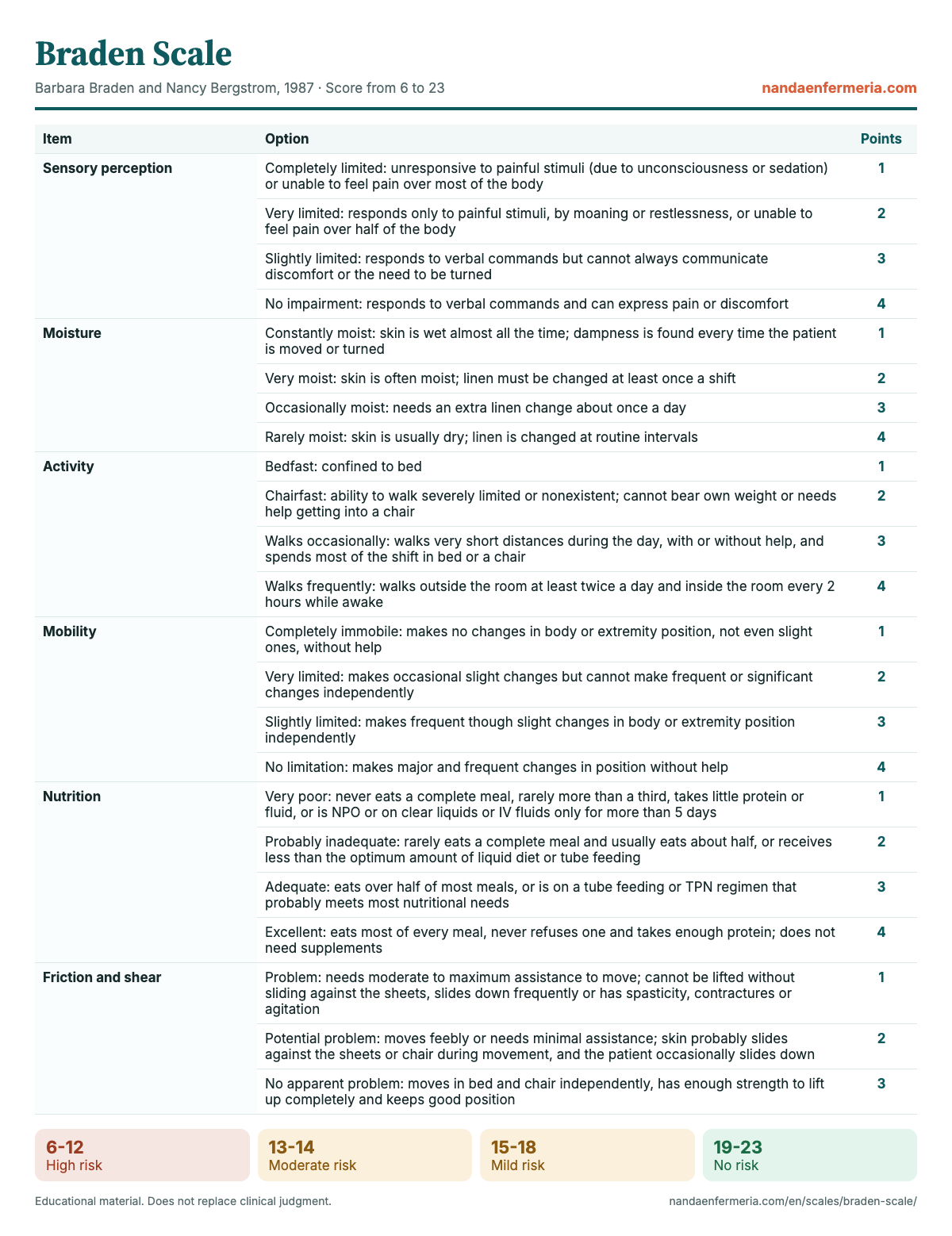
Sensory perception
Ability to respond meaningfully to pressure-related discomfort.
Moisture
Degree to which the skin is exposed to sweat, urine, stool or drainage.
Activity
The patient's level of physical activity over the day.
Mobility
Ability to change and control body position independently.
Nutrition
Usual food intake pattern.
Friction and shear
Skin rubbing against the sheets and sliding when the patient moves or is moved. This subscale is scored only from 1 to 3.
Result
0range 6 to 23
Review and change your answers
For guidance only; it does not replace clinical assessment or your facility's protocols. · Reviewed November 2, 2026 by the editorial team · Barbara Braden and Nancy Bergstrom, 1987
What it measures
It rates the factors that make skin break down from pressure and friction: the ability to feel discomfort, skin moisture, activity, mobility, nutrition and rubbing during movement. The result helps you decide how aggressive prevention needs to be, such as repositioning, support surfaces and skin care, and shows which specific factor you should correct.
Used in: Adults in the hospital, the ICU, long-term care or home care. Children are assessed with the pediatric Braden Q.
Score interpretation
| Score | Result | What it means |
|---|---|---|
| 6-12 | High risk | High likelihood of a pressure injury. Implement all preventive measures, use a pressure-redistribution support surface and inspect the skin every shift. |
| 13-14 | Moderate risk | Set up a turning schedule, protect bony prominences and correct the low-scoring subscales. Reassess as often as your facility's protocol requires. |
| 15-18 | Mild risk | Keep basic measures in place: mobilization, moisture control and skin hydration. In patients younger than 75, scores of 17 and 18 are often considered no risk. |
| 19-23 | No risk | No significant risk at this time. Reassess if the clinical condition or mobility changes, or on a new admission. |
Variations: Some protocols and studies use high risk below 13, moderate 13 to 14 and low 15 to 16 in patients younger than 75, or 15 to 18 in those 75 and older; this calculator shows the wider range (15 to 18) so no one is missed. Other tables split high risk into very high (9 or less) and high (10 to 12), and some sources use a single cutoff: 16 or less (or 18 or less in older adults) indicates risk. For children there is the Braden Q (Quigley and Curley, 1996), with seven subscales and a range of 7 to 28.
The scale at a glance
When to use it
- On admission for every hospitalized patient, within the first few hours.
- In patients who are bedbound, use a wheelchair or have reduced mobility.
- After surgery, sedation or ICU admission.
- When the clinical condition changes: fever, new incontinence, malnutrition or neurologic decline.
- Routinely in long-term care and home care.
- To choose the type of support surface and how often to reposition.
How to use it step by step
- Observe the patient and inspect the skin, especially the sacrum, heels, trochanters and areas under medical devices.
- Score each of the six subscales on what you see right now, not on the diagnosis.
- If you're torn between two options, choose the lower score (the less favorable one).
- Add up the points: the total ranges from 6 to 23.
- Classify the risk and document the score, the date and the lowest-scoring subscales.
- Plan care according to the risk level and reassess when the patient's condition changes or per your protocol.
Common mistakes
- Scoring friction and shear from 1 to 4: this subscale only goes up to 3.
- Assessing only once on admission and not repeating it when the patient gets worse.
- Looking only at the total and not correcting low-scoring subscales such as moisture or nutrition.
- Scoring what the patient could do instead of what they actually do.
- Replacing skin inspection with the score: the scale does not detect injuries that are already there.
Case study
Patient. A 78-year-old woman admitted for pneumonia, with residual deficits from a previous stroke.
- Responds to verbal commands but does not always report discomfort: sensory perception 3
- Urinary incontinence; linen is changed once a shift: moisture 2
- Stays in bed: activity 1
- Makes only occasional slight position changes: mobility 2
- Eats about half of each meal: nutrition 2
- Slides toward the foot of the bed and needs help to reposition: friction and shear 1
Score: 11. A total of 11 points indicates high risk for a pressure injury.
Nursing actions:
- Place a pressure-redistribution support surface and set up a turning schedule.
- Manage incontinence, cleanse and protect the perineal skin with barrier products.
- Keep the head of the bed as low as tolerated and use a lift sheet or device to move her without dragging.
- Request a dietitian consult and monitor intake.
- Inspect the heels and sacrum every shift and reassess the Braden score per protocol.
Related NANDA nursing diagnoses
The score on this scale often supports these nursing diagnoses:
Frequently asked questions
What is a normal Braden score, and what score means at risk?
A score of 19 to 23 is considered no risk. 15 to 18 is mild risk, 13 to 14 moderate risk and 12 or less high risk. For patients younger than 75, many protocols consider 17 and above as no risk.
What are the lowest and highest possible Braden scores?
The lowest is 6 and the highest is 23. Five subscales are scored from 1 to 4, and friction and shear from 1 to 3.
How often should you do a Braden assessment?
On admission, then according to your facility's protocol and the risk level, and any time the patient's condition changes, for example after surgery or when incontinence develops.
What is the difference between the Braden and Norton scales?
The Norton scale is older and has five items (5 to 20 points). Braden adds nutrition and friction and shear, and it is the more widely used of the two in hospitals.
Can the Braden Scale be used in children?
Not the adult version. Pediatrics uses the Braden Q, which adds a tissue perfusion and oxygenation subscale.
Does a high Braden score mean prevention isn't needed?
Not entirely. The scale is a guide, but clinical judgment comes first: a patient with a good score and a tight medical device, for example, can still develop an injury.
Other scales
Sources: Tzuc-Guardia A, et al. Risk level and occurrence of pressure ulcers (Enfermería Universitaria, 2015, in Spanish) · Galician Health Service. Braden-Bergstrom Scale (in Spanish) · Virgen de las Nieves University Hospital. Braden Scale questionnaire (in Spanish) · IMSS clinical practice guideline: prevention, diagnosis and management of pressure ulcers (in Spanish) · Lima-Serrano M, et al. Predictive validity of the Braden Scale in the ICU (Medicina Intensiva, 2018). Explanatory text and case study written by our editorial team. Reviewed November 2, 2026.