Pain intensity
Ask the patient to mark on the 10 cm line how much it hurts right now; measure in centimeters from the "no pain" end.
Result
0range 0 to 10
For guidance only; it does not replace clinical assessment or your facility's protocols. · Reviewed November 2, 2026 by the editorial team · Huskisson, 1974
What it measures
It turns pain intensity, as the patient perceives it, into a number: the patient marks a point on an unnumbered line between "no pain" and "worst pain imaginable". It helps you decide whether pain needs to be addressed, compare before and after an intervention and track pain over the day with a simple, reproducible measure.
Used in: Adults and children from about age 7 or 8 who can understand the line and mark it. It is not useful in patients with cognitive impairment, sedated patients or those who cannot communicate.
Score interpretation
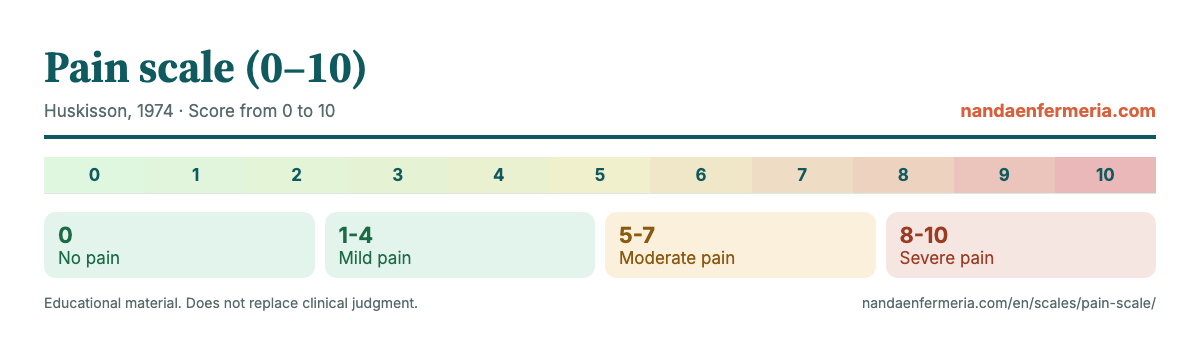
| Score | Result | What it means |
|---|---|---|
| 0 | No pain | The patient reports no pain. Keep assessing at every check or if the situation changes. |
| 1-4 | Mild pain | Mild pain. Provide comfort measures and the ordered analgesic plan, then reassess. |
| 5-7 | Moderate pain | Moderate pain. Review the analgesic plan with the provider and reassess after each intervention. |
| 8-10 | Severe pain | Severe pain. Notify the provider promptly, look for the cause and reassess soon. |
Variations: Cutoffs vary by source: this tool uses up to 4 mild, 5-7 moderate and above 7 severe (consistent with Hawker 2011 in millimeters); other references use under 3 mild, 4-7 moderate and 8 or more severe, and many guidelines use 1-3, 4-6 and 7-10. The VAS has no visible numbers: the patient marks a point on the line and you measure it. The numeric rating scale (NRS) asks the patient directly for a number from 0 to 10; it is easier to use, even over the phone or verbally, and both give similar results, but they are not interchangeable when you are trending the same patient.
The scale at a glance
When to use it
- Pain assessment as the fifth vital sign on inpatient units.
- Postoperative pain management.
- Before and after giving an ordered analgesic, to measure its effect.
- Chronic pain follow-up in the clinic.
- Pain assessment in the ED and during painful procedures.
How to use it step by step
- Make sure the patient is alert, understands the instructions and can see the line clearly.
- Show a 10 cm horizontal line with "no pain" at the left end and "worst pain imaginable" at the right, with no numbers or marks.
- Ask the patient to mark the point that represents their pain right now; don't suggest an answer.
- Use a ruler to measure the distance in centimeters from the "no pain" end to the mark.
- Document the value, the time, the location of the pain and whether it was at rest or with movement.
- Repeat the measurement after each intervention using the same scale.
Common mistakes
- Showing the line with numbers, which turns it into a numeric scale.
- Estimating pain from the patient's facial expression instead of asking them to mark it.
- Using photocopied lines that no longer measure 10 cm, which skews the result.
- Using it in patients with cognitive impairment or sedation, who need behavioral pain scales.
- Switching scales between measurements and comparing the values as if they were equivalent.
Case study
Patient. A 45-year-old woman on postoperative day 1 after an open cholecystectomy.
- Reports incisional pain when moving and coughing.
- Marks the line 7 cm from the "no pain" end.
- Heart rate 102 bpm and guarding posture.
- VAS score: 7.
Score: 7. VAS 7: moderate pain, bordering on severe. It is limiting mobilization and effective coughing.
Nursing actions:
- Notify the provider and review the ordered analgesic plan.
- Teach her to splint the incision with a pillow when coughing and moving.
- Help her into a comfortable position and use nonpharmacologic measures.
- Reassess with the VAS after the intervention and document the change.
Related NANDA nursing diagnoses
The score on this scale often supports these nursing diagnoses:
Frequently asked questions
What pain scale score is normal, and when is it a concern?
0 means no pain. Up to 4 is considered mild pain, 5 to 7 moderate and above 7 severe. From moderate pain on, it's a good idea to review the analgesic plan with the provider.
What is the difference between the visual analog scale and the numeric pain scale?
With the VAS, the patient marks a point on an unnumbered line and you measure the distance. With the numeric rating scale, the patient says a number from 0 to 10. The numeric scale is faster and can be done verbally; the VAS needs the printed line.
How do you measure a VAS score?
With a ruler, in centimeters or millimeters, from the "no pain" end to the patient's mark. A mark at 63 mm equals 6.3.
Can the 0–10 pain scale be used in children?
It usually works from age 7 or 8. Younger children do better with faces scales, such as the Wong-Baker FACES scale.
Which pain scale do you use if the patient can't communicate?
The VAS depends on what the patient reports. Sedated, intubated or patients with dementia are assessed with behavioral scales such as the BPS, CPOT or PAINAD.
Other scales
Sources: Visual analog pain scale (VAS) - Galician Health Service (in Spanish) · Pain scales VRS, VAS, NRS and FPS - SECOT (in Spanish) · Pain assessment scales - Fuenlabrada Hospital, Community of Madrid (in Spanish) · Pain Visual Analogue Scale (Hawker 2011) - University of British Columbia · Measurement of pain - Huskisson, The Lancet 1974. Explanatory text and case study written by our editorial team. Reviewed November 2, 2026.