Eye opening (E)
Observe first without touching; if the eyes stay closed, speak to the patient, then apply nail bed or trapezius pressure.
Verbal response (V)
Ask the patient their name, where they are and the month or year.
Motor response (M)
Ask the patient to follow a simple command; if they don't, apply pressure and record the best response from either arm.
Result
0range 3 to 15
Review and change your answers
For guidance only; it does not replace clinical assessment or your facility's protocols. · Reviewed November 2, 2026 by the editorial team · Teasdale and Jennett, 1974
What it measures
It rates how awake and responsive the patient is by watching whether they open their eyes, how they talk and how they move to commands or stimuli. It is used to classify the severity of a traumatic brain injury, track neurologic status hour by hour and give nursing, the ED and neurosurgery a shared language for describing the patient.
Used in: Adults and children old enough to talk. Infants and children under 2 are assessed with the pediatric version, which uses an adapted verbal response.
Score interpretation
| Score | Result | What it means |
|---|---|---|
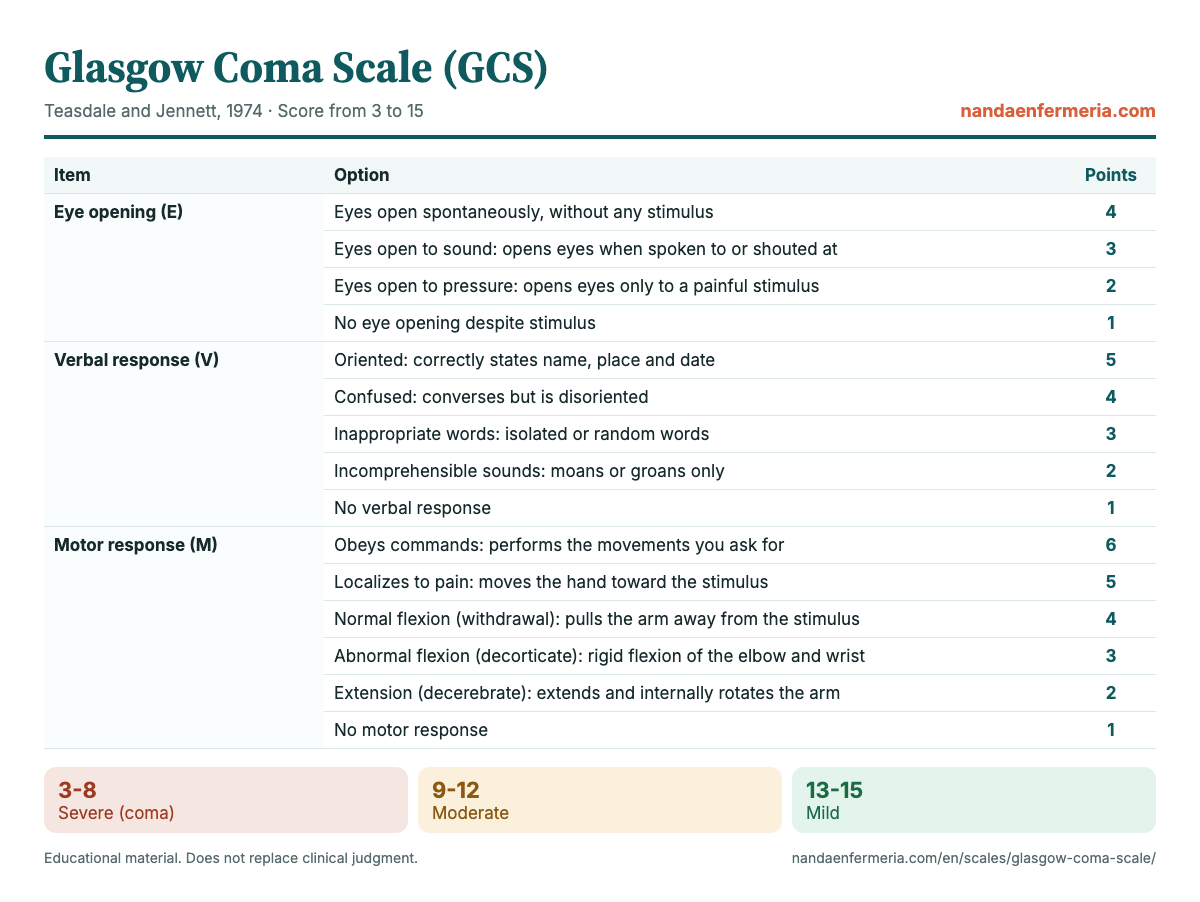
| 3-8 | Severe (coma) | Severely impaired consciousness with a risk of losing the airway. Notify the provider immediately and prepare ventilatory support per protocol. |
| 9-12 | Moderate | Moderately impaired consciousness. Needs prompt medical evaluation and frequent neuro checks. |
| 13-15 | Mild | Consciousness intact or mildly impaired; 15 is a fully responsive patient. Keep monitoring: a drop of 2 or more points is a red flag. |
Variations: Infants are assessed with the modified Glasgow Coma Scale, where the verbal response is scored as smiles and follows sounds (5), irritable but consolable (4), cries to pain (3), moans to pain (2) and no response (1). The GCS-P (Brennan, Murray and Teasdale, 2018) subtracts a pupil reactivity score from the total: 2 if neither pupil reacts to light, 1 if one does not react and 0 if both react, for a range of 1 to 15. In intubated patients the verbal score is charted as "T" (not testable) instead of assigning 1.
The scale at a glance
When to use it
- Initial assessment of a patient with a traumatic brain injury.
- Neuro monitoring after cranial surgery or a stroke.
- Patients with poisoning, hypoglycemia or a metabolic disturbance affecting consciousness.
- ED triage and prehospital care.
- Hourly neuro checks in the ICU to catch early deterioration.
How to use it step by step
- Check for factors that interfere with the assessment: sedation, intubation, aphasia, deafness, limb injuries or language barriers.
- Observe the patient without touching them and note whether they open their eyes, speak or move spontaneously.
- Speak in a normal voice, then louder; give a simple command such as squeezing and releasing your hand.
- If there is no response, apply nail bed, trapezius or supraorbital notch pressure for about 10 seconds.
- Score the best response in each component and document the breakdown (for example E3 V4 M6 = 13), not just the total.
- Compare with the previous assessment and report a drop of 2 or more points or any change in the pupils.
Common mistakes
- Charting only the total without the E, V and M breakdown, which hides which component changed.
- Scoring an intubated patient's verbal response as 1 instead of charting it as not testable (T).
- Confusing withdrawal from pain with localizing to the stimulus.
- Using "squeeze my hand" alone as the command: a grasp reflex is not the same as obeying.
- Assessing a sedated patient without documenting the sedation.
Case study
Patient. A 34-year-old man arrives at the ED after a motorcycle crash; he was not wearing a helmet.
- Opens his eyes only to nail bed pressure (E2: 2 points).
- Says isolated words unrelated to the question (V3: 3 points).
- Moves his hand toward the painful stimulus (M5: 5 points).
- Pupils equal and reactive to light.
Score: 10. GCS 10 (E2 V3 M5): moderately impaired consciousness from a traumatic brain injury. Pupils are reactive, so the GCS-P is also 10.
Nursing actions:
- Notify the provider and support the request for a head CT.
- Maintain cervical spine immobilization until injury is ruled out.
- Reassess GCS and pupils every 15 to 30 minutes or as ordered.
- Monitor the airway and keep suction equipment ready.
- Document the breakdown and the time of every assessment.
Related NANDA nursing diagnoses
The score on this scale often supports these nursing diagnoses:
Frequently asked questions
What is a normal Glasgow Coma Scale score?
An alert, oriented patient scores 15. A score of 13 to 15 is considered mild impairment, 9 to 12 moderate and 3 to 8 severe. A total of 8 or less is associated with coma.
What is the lowest possible GCS score?
The lowest score is 3, not 0, because each component is worth at least 1 point even when there is no response.
What does "GCS less than 8, intubate" mean?
At 8 or less the patient often cannot protect their own airway. It is a warning sign weighed together with the rest of the clinical picture; the decision to intubate belongs to the medical team.
How do you score GCS in an intubated patient?
The verbal response cannot be assessed. It is charted as "T" or "NT" (for example E2 VT M4) and documented that way instead of assigning 1 point.
What is the GCS-P?
It is the GCS total minus the pupil reactivity score (0, 1 or 2 depending on how many pupils fail to react to light). It gives a more precise picture of severity in traumatic brain injury.
Is the Glasgow Coma Scale used the same way in children?
In children who can already talk it is applied almost the same way. In infants the verbal response changes and is scored on smiling, crying and consolability.
Other scales
Sources: Glasgow Coma Scale (official site, Teasdale et al.) · What is GCS-P - Glasgow Coma Scale · Glasgow Coma Scale - StatPearls, NCBI · Head trauma - Spanish Association of Pediatrics protocols (pediatric table, in Spanish) · Modified Glasgow Coma Scale for infants and children - MSD Manual (Spanish edition). Explanatory text and case study written by our editorial team. Reviewed November 2, 2026.