History of falling
A fall during this admission or in the past 3 months.
Secondary diagnosis
More than one active medical diagnosis in the chart.
Ambulatory aid
Choose what the patient uses to get around.
IV/Heparin lock
Gait
Watch the patient stand up and take a few steps.
Mental status
Ask whether they can go to the bathroom on their own and compare the answer with your assessment.
Result
0range 0 to 125
Review and change your answers
For guidance only; it does not replace clinical assessment or your facility's protocols. · Reviewed November 2, 2026 by the editorial team · Janice M. Morse, Robert M. Morse and Suzanne J. Tylko, 1989
What it measures
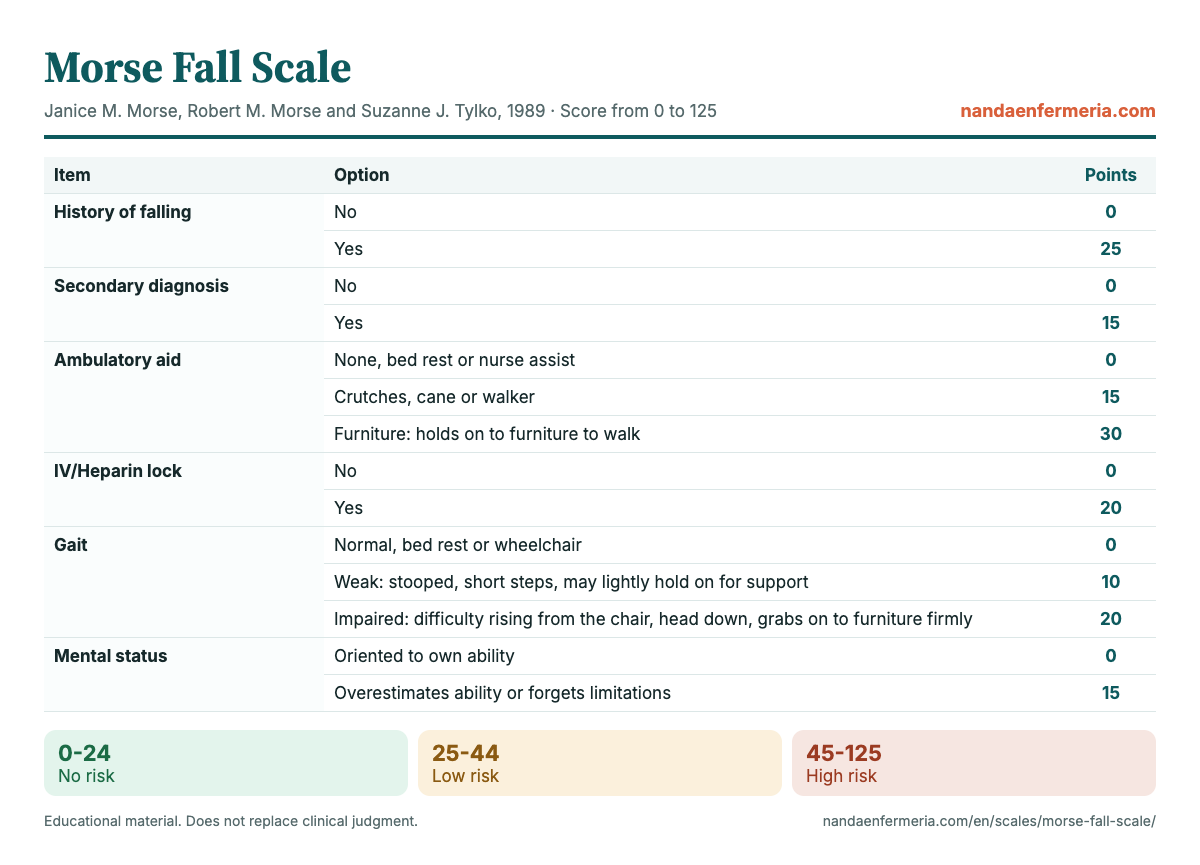
It rates six factors linked to falls in the hospital: history of falling, secondary diagnosis, ambulatory aid, IV access, type of gait and awareness of one's own limitations. Each item carries a different weight based on how strongly it relates to falls. The total tells you what level of fall precautions the patient needs.
Used in: Hospitalized adults (med-surg, long-term care). It is not validated for pediatrics.
Score interpretation
| Score | Result | What it means |
|---|---|---|
| 0-24 | No risk | Continue basic nursing care and reassess if the patient's condition changes. |
| 25-44 | Low risk | Implement your unit's standard fall prevention interventions. |
| 45-125 | High risk | Start the high-risk fall precautions in your protocol, document the risk and notify the team. |
Variations: The cutoffs 0-24, 25-44 and 45 or more are the most widely cited and come from the original study. Many hospitals use 0-24 no risk, 25-50 low risk and over 50 high risk instead. Morse herself recommends that each facility adjust the cutoff to its own patient population.
The scale at a glance
When to use it
- On admission of an adult patient to the hospital.
- Every shift or as often as your unit's protocol requires.
- After surgery, sedation or a major change in treatment.
- After a fall.
- When mobility or mental status changes.
- When the patient is transferred to another unit.
How to use it step by step
- Check the chart for previous falls and active diagnoses.
- Check whether the patient has an IV or a saline/heparin lock.
- Note what ambulatory aid they use and observe their gait.
- Ask whether they can get up on their own and compare with their actual ability.
- Add up the points for all six items and find the risk level.
- Document the score and the interventions you put in place; reassess per your protocol.
Common mistakes
- Scoring gait without watching the patient walk.
- Scoring 0 for ambulatory aid when the patient holds on to furniture.
- Forgetting a heparin or saline lock with no infusion running: it still counts.
- Using the 45 cutoff when your facility adopted 51, or vice versa: follow your local protocol.
- Not repeating the scale after clinical changes or a fall.
Case study
Patient. A 72-year-old man on postoperative day 2 after hip surgery, with diabetes and hypertension.
- No previous falls (0 points).
- Secondary diagnosis: diabetes and hypertension (15 points).
- Walks with a walker (15 points).
- Has an IV (20 points).
- Weak gait, short steps (10 points).
- Aware of his limitations (0 points).
Score: 60. High fall risk (60 points, above the cutoff of 45).
Nursing actions:
- Document the risk and apply the visual fall-risk identifier your protocol requires.
- Bed in low position with wheels locked, side rails per protocol and call light within reach.
- Assist him every time he gets up and to the bathroom.
- Keep the walker next to the bed and the floor free of clutter.
- Reassess when the IV is removed or his gait improves.
Related NANDA nursing diagnoses
The score on this scale often supports these nursing diagnoses:
Frequently asked questions
What Morse Fall Scale score is considered high risk?
Using the most widely cited cutoffs, 0 to 24 is no risk, 25 to 44 low risk and 45 or more high risk. Some facilities set high risk at over 50.
What is the highest possible Morse Fall Scale score?
125 points: 25 for history of falling, 15 for secondary diagnosis, 30 for ambulatory aid, 20 for IV/heparin lock, 20 for gait and 15 for mental status.
Does a patient on bed rest get points for gait?
No. Bed rest or wheelchair use scores 0 for both gait and ambulatory aid.
How often should the Morse Fall Scale be done?
On admission, after any significant clinical change, after a fall and as often as your facility requires, usually every shift or every day.
Can the Morse Fall Scale be used in children?
It was not designed for pediatrics. Children are assessed with specific tools, such as the Humpty Dumpty Falls Scale or pediatric adaptations of the Downton index.
Other scales
Sources: Fall risk assessment, Morse Fall Scale (Andalusian Health Service, in Spanish) · Morse Fall Scale, Fall Prevention Toolkit (AHRQ) · Is the Morse Fall Scale the most suitable tool for assessing fall risk? (Rev Esp Geriatr Gerontol, in Spanish). Explanatory text and case study written by our editorial team. Reviewed November 2, 2026.