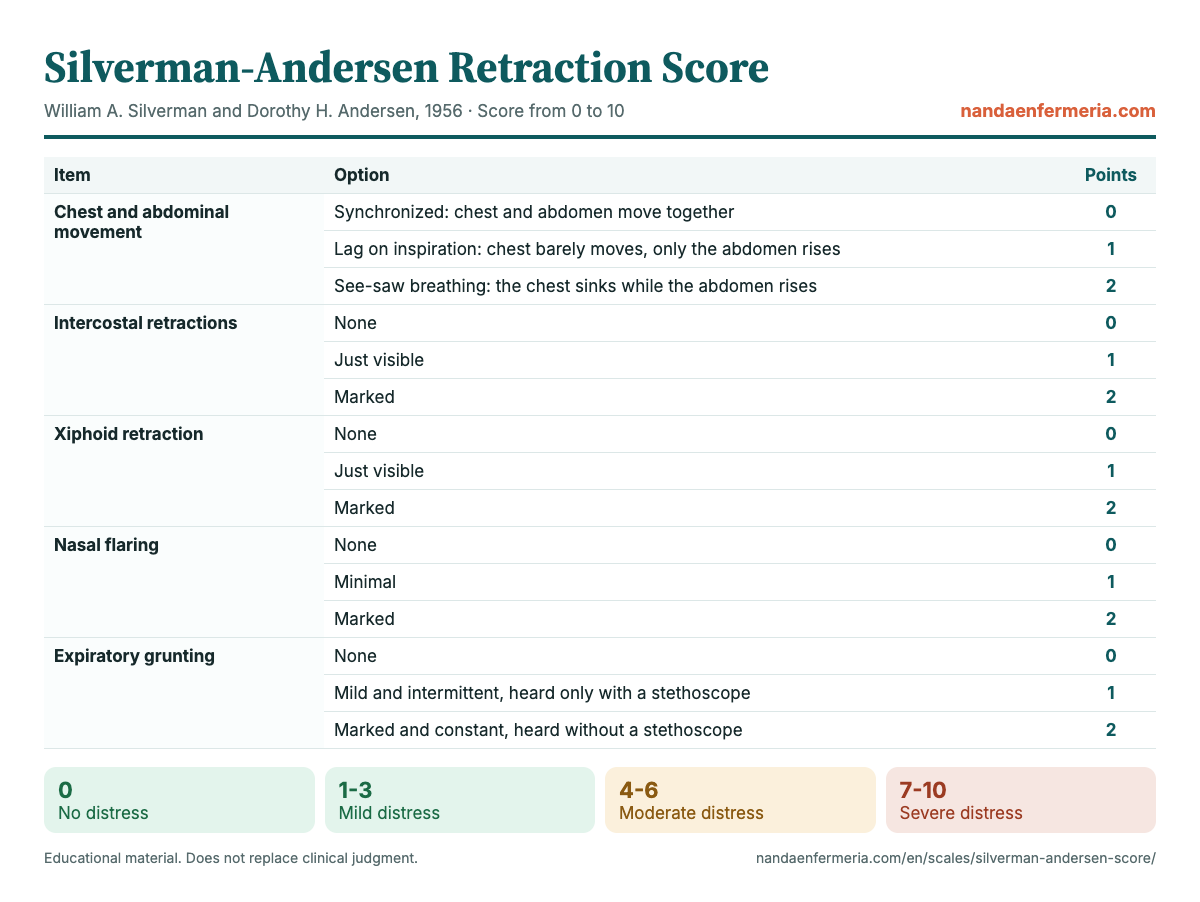
Chest and abdominal movement
Watch whether the chest and abdomen rise and fall together during inspiration.
Intercostal retractions
Look at the spaces between the ribs during inspiration.
Xiphoid retraction
Look for sinking just below the sternum, at the tip of the xiphoid process.
Nasal flaring
Watch whether the nostrils flare with each inspiration.
Expiratory grunting
Listen at the end of expiration, first with a stethoscope and then without one.
Result
0range 0 to 10
Review and change your answers
For guidance only; it does not replace clinical assessment or your facility's protocols. · Reviewed November 2, 2026 by the editorial team · William A. Silverman and Dorothy H. Andersen, 1956
What it measures
It measures a newborn's work of breathing using signs you can see without any equipment: synchrony of chest and abdominal movement, intercostal retractions, xiphoid retraction, nasal flaring, and expiratory grunting. It helps you recognize respiratory distress, track it hour by hour, and support the decision to start oxygen or respiratory support. It does not measure oxygenation, so pair it with pulse oximetry, respiratory rate, and a full clinical assessment.
Used in: Term and preterm newborns, especially in the first hours of life and any time there are signs of respiratory distress.
Score interpretation
| Score | Result | What it means |
|---|---|---|
| 0 | No distress | No signs of respiratory distress. Continue routine newborn monitoring. |
| 1-3 | Mild distress | Mild respiratory distress. It can be part of the transition in the first hours of life; reassess often and monitor SpO2 and respiratory rate. |
| 4-6 | Moderate distress | Moderate respiratory distress. Notify the provider, start continuous SpO2 monitoring, and be ready to give oxygen as ordered. |
| 7-10 | Severe distress | Severe respiratory distress with a risk of respiratory failure. Needs immediate evaluation by the provider and usually requires respiratory support. |
Variations: The most widely used cutoffs are 0 for no distress, 1-3 mild, 4-6 moderate, and 7-10 severe. Some national guidelines word the ranges differently (for example, mild up to 3, moderate 3 to 5, severe above 5) and state that a score above 7 calls for ventilatory assistance. Some texts consider a score of up to 2 acceptable during the transition in the first minutes after birth.
The scale at a glance
When to use it
- Newborn assessment in the delivery room and throughout the transition period.
- Newborns with tachypnea, grunting, nasal flaring, retractions, or cyanosis.
- Preterm infants at risk for respiratory distress syndrome.
- Infants born by cesarean without labor, to mothers with diabetes, or after prolonged rupture of membranes.
- Tracking the response to oxygen, CPAP, or other respiratory support.
- Newborn transport, to document respiratory status before and after.
How to use it step by step
- Place the baby supine and calm, with the chest and abdomen uncovered, in a neutral thermal environment.
- Watch chest and abdominal movement for at least one minute before touching the baby.
- Assess intercostal retractions, xiphoid retraction, and nasal flaring during inspiration.
- Listen for grunting at the end of expiration, first with a stethoscope and then from a distance.
- Give each sign 0, 1, or 2 points, add them up, and document the time, FiO2, and SpO2 at that moment.
- Repeat the assessment at regular intervals to follow the trend, and report a rising score.
Common mistakes
- Reading it like the Apgar: on the Silverman-Andersen score, 0 is best and 10 is worst.
- Scoring the baby while crying or agitated, which exaggerates retractions and flaring.
- Mistaking a newborn's normal abdominal breathing for see-saw breathing.
- Documenting a single score without repeating it: the trend over time is what matters.
- Using the score alone, without respiratory rate, SpO2, and color.
Case study
Patient. Female newborn, 34 weeks, delivered by cesarean, 40 minutes old, respiratory rate 72 breaths/min.
- Chest barely moves, only the abdomen rises: 1 point
- Marked intercostal retractions: 2 points
- Just visible xiphoid retraction: 1 point
- Minimal nasal flaring: 1 point
- Mild, intermittent grunting heard only with a stethoscope: 1 point
Score: 6. Silverman-Andersen score of 6: moderate respiratory distress, bordering on severe. Needs prompt evaluation by the provider and continuous monitoring.
Nursing actions:
- Notify the provider and document the score with the time, respiratory rate, and SpO2.
- Start continuous pulse oximetry and give oxygen as ordered.
- Maintain a neutral thermal environment and keep handling to a minimum.
- Reassess the score every 30 to 60 minutes, or sooner if she worsens, and have respiratory support equipment ready.
Related NANDA nursing diagnoses
The score on this scale often supports these nursing diagnoses:
Frequently asked questions
What is a normal Silverman-Andersen score?
A score of 0 means no respiratory distress. A score of 1 to 3 is mild distress, 4 to 6 moderate, and 7 to 10 severe. During the transition in the first minutes of life you may see a low score that resolves on its own.
Why is a higher score worse on this scale?
Because every point adds a sign of respiratory effort. Unlike the Apgar, where 10 is best, here 10 means the most severe distress.
How often should the Silverman-Andersen score be repeated?
It depends on the baby's condition and your unit's protocol. With moderate or severe distress it is repeated frequently, often every 30 to 60 minutes, and any time the clinical picture or respiratory support changes.
What's the difference between the Silverman-Andersen score and the Apgar?
The Apgar assesses overall adaptation at birth at 1 and 5 minutes. The Silverman-Andersen score focuses on work of breathing and can be used at any point in the neonatal period.
Does a high score always mean the baby needs intubation?
No. It guides severity, but the decision to give oxygen, CPAP, or mechanical ventilation is made by the medical team based on SpO2, blood gases, and how the baby is trending.
Other scales
Sources: Mexican official standard NOM-007-SSA2-2016, Appendix G (Silverman-Andersen assessment, Spanish) · Silverman-Andersen test: calculation and interpretation. Miroteca (Spanish) · Care of the healthy newborn. Acta Pediátrica de México 2014 (Spanish) · The Silverman score in neonatal respiratory distress. Dialnet (Spanish). Explanatory text and case study written by our editorial team. Reviewed November 2, 2026.